Casting Simulation: How Digital Technology Optimizes Casting Design Before Metal Is Poured
2026-09-04
Meta Description: A technical guide to casting simulation software (MAGMASOFT, ProCAST, AnyCasting, FLOW-3D CAST). Learn mold filling analysis, solidification modeling, shrinkage prediction, gating and riser optimization, and how simulation prevents defects before tooling is built.
In the traditional foundry, casting design was an iterative gamble: pour, inspect, find defects, modify the gating system, pour again. Each cycle cost weeks and thousands of dollars in tooling and metal — and the "final" solution was only as good as the foundryman's accumulated experience.
Modern casting simulation changes this. Before a single mold is made, engineers can digitally pour the part, watch the metal flow, observe solidification, and predict where defects will form. They can test twenty gating designs in a week — not a year.
This guide explains what casting simulation does, how it works, what it predicts, and why it has become the standard of engineering practice in world-class foundries.
1. What Casting Simulation Does
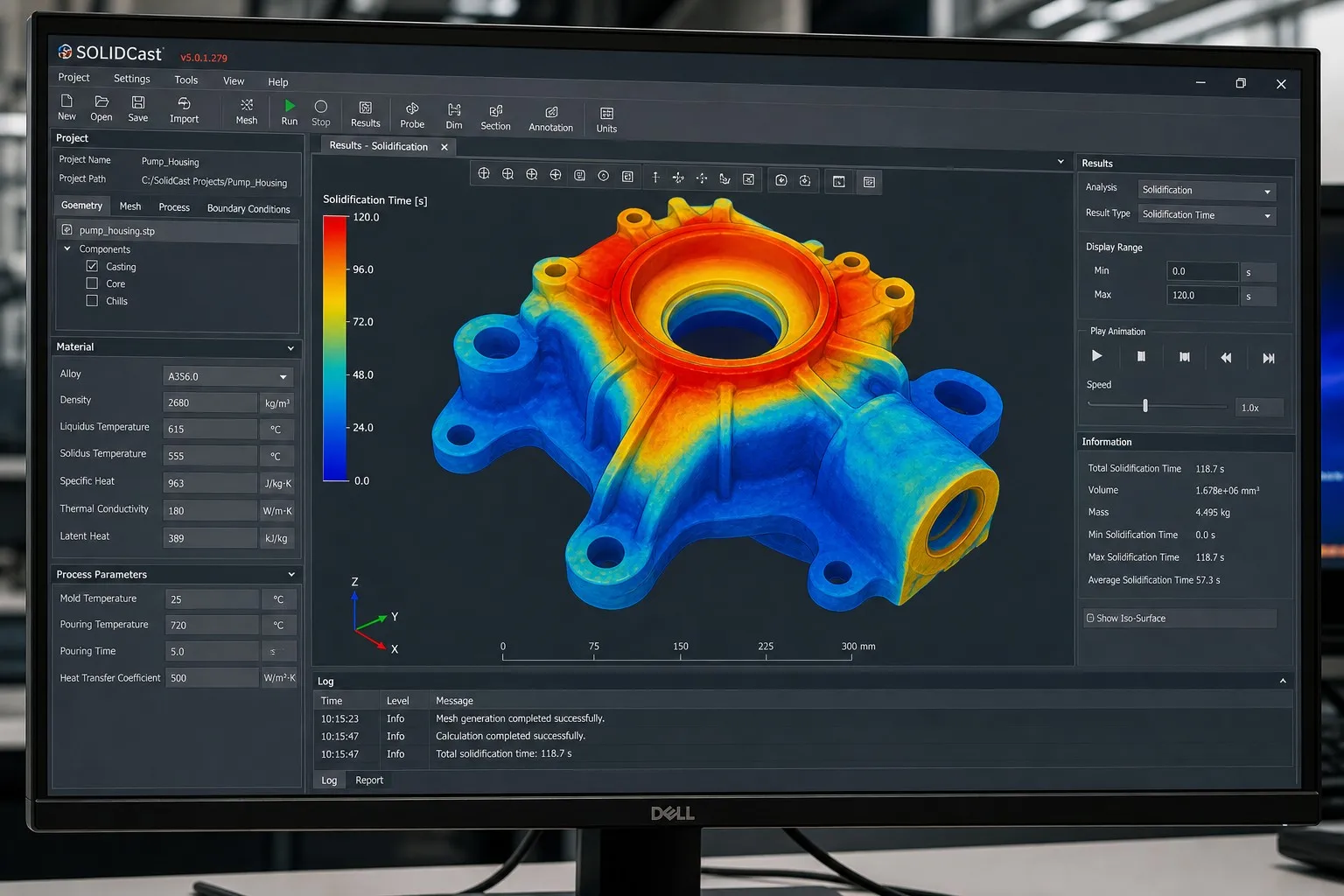
Casting simulation uses computational fluid dynamics (CFD) and finite element/volume methods (FEM/FVM) to model the physics of the casting process:
| Physics Modeled | What It Predicts |
|---|---|
| Mold filling (CFD) | Flow front, turbulence, air entrapment, cold shuts |
| Heat transfer and solidification | Cooling rate, solidification time, hot spots |
| Shrinkage and porosity | Macro-shrinkage location, micro-porosity |
| Thermal stress | Distortion, warpage, hot tearing |
| Microstructure | Grain size, phase fractions, mechanical properties |
| Residual stress | Post-heat-treatment distortion |
Leading Software
| Software | Developer | Strengths |
|---|---|---|
| MAGMASOFT | MAGMA GmbH | Industry standard, comprehensive modules, optimization engine |
| ProCAST | ESI Group | Coupled stress and microstructure, investment casting |
| AnyCasting | AnyCasting Co. | Fast solver, user-friendly, die casting strength |
| FLOW-3D CAST | Flow Science | Excellent free-surface flow modeling |
| SolidCast / Click2Cast | Finite Solutions | Fast, affordable sand casting simulation |
2. The Simulation Workflow
2.1 Model Preparation
- Import CAD geometry (casting + tooling/mold)
- Define material data (alloy properties, mold/sand properties)
- Define process parameters (pouring temperature, time, method)
- Mesh the model (finer mesh = more accurate, longer solve)
2.2 Mold Filling Simulation
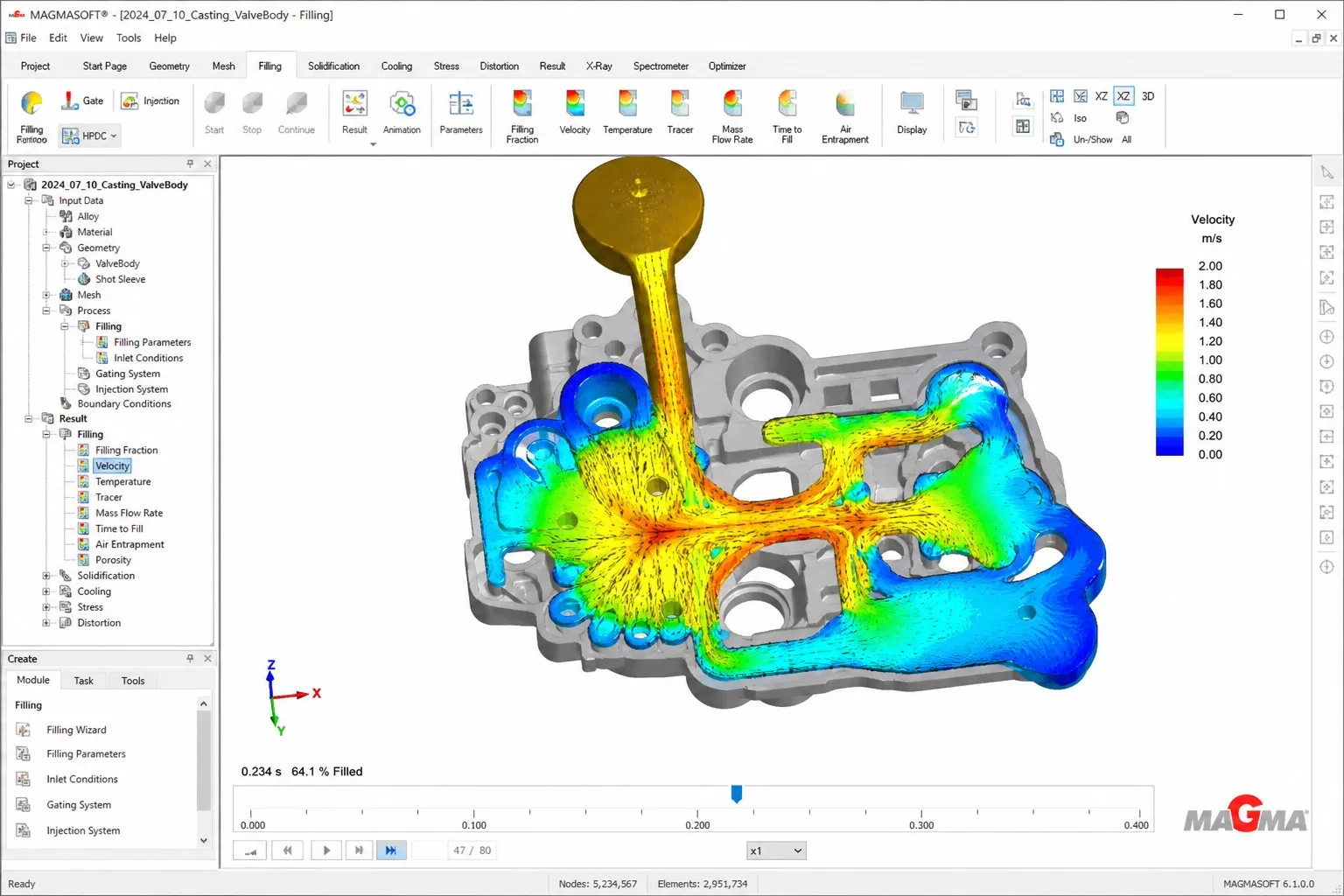
The first analysis stage predicts how liquid metal fills the mold:
- Flow front progression — uniform, controlled filling vs. turbulent, splashing fill
- Velocity distribution — critical: high velocity causes sand erosion and air entrapment
- Air entrapment — trapped air becomes gas porosity in the final casting
- Cold shut risk — converging flow fronts that meet too cold to fuse
Typical filling velocity guidance: the gating system should keep the flow front below ~0.5 m/s in sand casting to avoid mold erosion and turbulence.
2.3 Solidification and Shrinkage Analysis
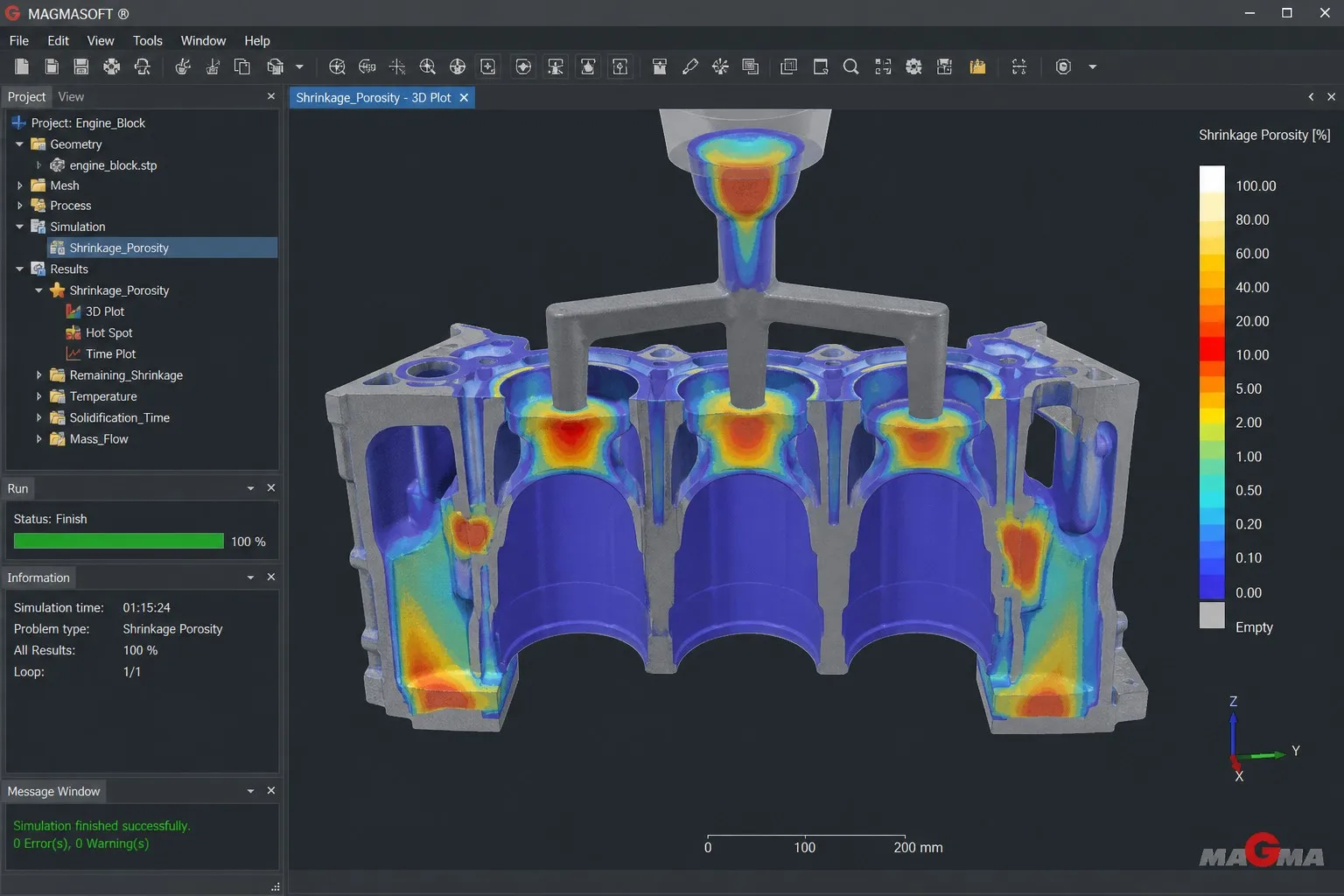
The most important stage for defect prediction:
| Prediction | What the Engineer Looks For |
|---|---|
| Solidification time | Isolated hot spots = last-to-solidify regions |
| Temperature gradient | Directional solidification toward risers |
| Hot spots | Centers of thick sections, junctions |
| Shrinkage porosity | Regions where feed metal cannot reach |
| Modulus analysis | Feeder design: is the riser big enough? |
The rule of directional solidification: metal must solidify from the thinnest section toward the riser, so that shrinkage occurs in the riser — not in the part.
2.4 Gating and Riser Optimization
Simulation turns gating design from art into engineering:
| Design Element | Simulation Guidance |
|---|---|
| Gating ratio | Fill rate and velocity control |
| Sprue and runner geometry | Smooth flow, minimal turbulence |
| Riser size and position | Correct feeding volume and distance |
| Chills | Accelerate cooling in heavy sections |
| Filter placement | Remove slag and oxides |
| Pouring method | Top/bottom/side gating comparison |
With modern optimization modules, the software can automatically search hundreds of design variants to find the robust solution — maximizing yield (casting weight / total poured weight) while meeting quality criteria.
3. Advanced Simulation Capabilities
3.1 Thermal Stress and Distortion
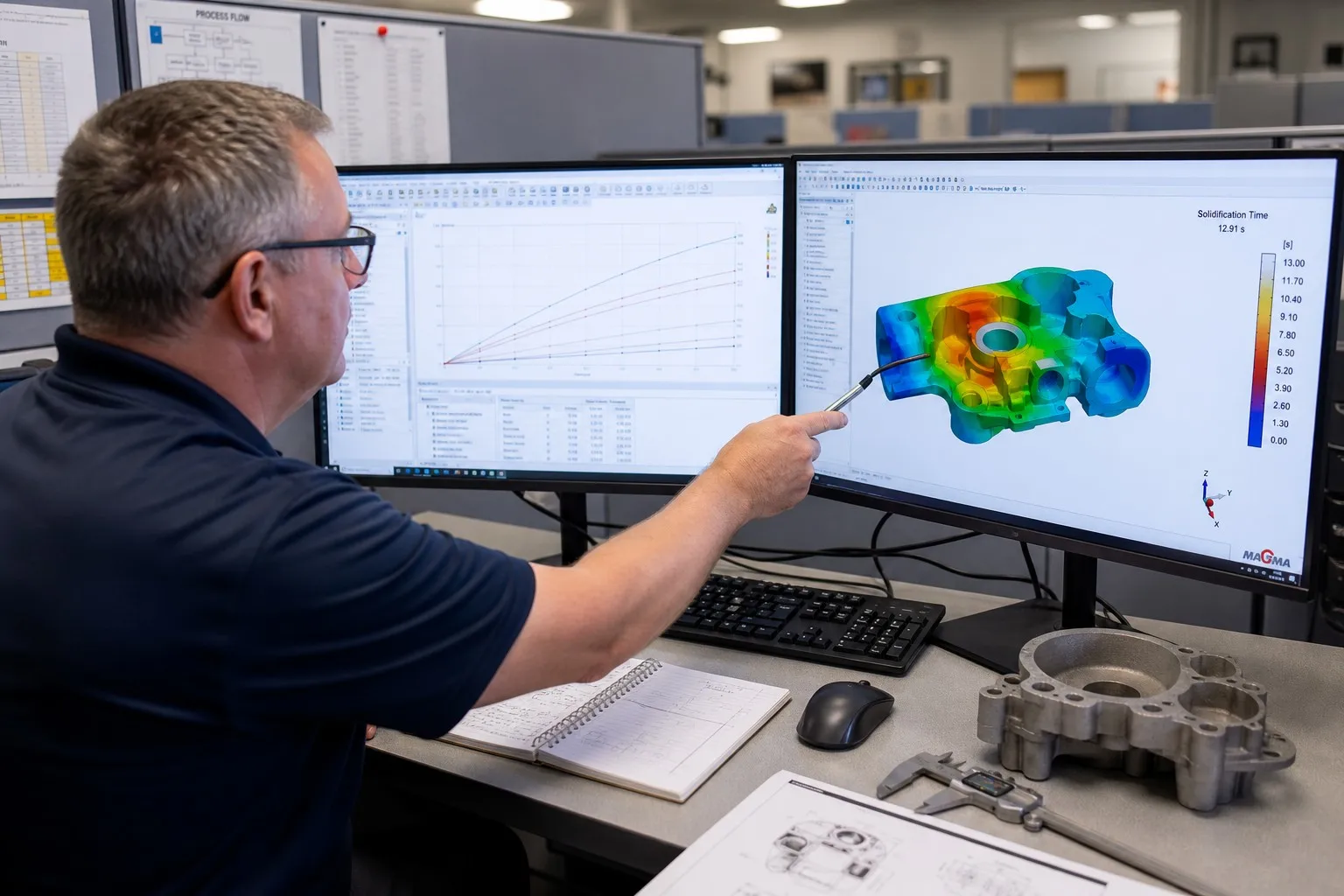
- Predicts warpage from differential cooling
- Predicts hot tearing at constrained sections
- Supports pattern compensation: the pattern is built oversized so the distorted casting comes back to nominal after cooling
3.2 Microstructure and Property Prediction
| Material | Predicted Properties |
|---|---|
| Ductile iron | Nodule count, ferrite/pearlite ratio, hardness |
| Steel | Grain size, phase transformations |
| Aluminum | Dendrite arm spacing (DAS), porosity level, mechanical properties |
| Superalloys | Grain structure, micro-porosity (investment castings) |
3.3 Multi-Process Modeling
| Process | Simulation Focus |
|---|---|
| Sand casting | Filling, solidification, defects |
| Investment casting | Shell filling, preheat, radiation heat transfer |
| Die casting | Flow, die temperature, cycle time |
| Centrifugal casting | Rotation effects on flow and segregation |
| Continuous casting | Solidification front stability |
4. Simulation in the Product Development Timeline
| Stage | Simulation Value |
|---|---|
| Concept design | Early castability check — before tooling |
| Design freeze | DFM feedback: wall thickness, radii, draft |
| Tooling design | Gating/riser layout, pattern compensation |
| Prototype | Validate the tooling design before first pour |
| Production launch | Process window definition (robustness) |
| Troubleshooting | Defect analysis: what changed? |
The critical benefit: simulation moves defect prevention to before tooling — when a design change costs a PDF edit, not a pattern rebuild.
5. Validation: Simulation vs. Reality
Simulation is only valuable if it matches reality. Validation practice:
| Step | Method |
|---|---|
| First article pour | Compare actual casting to simulated predictions |
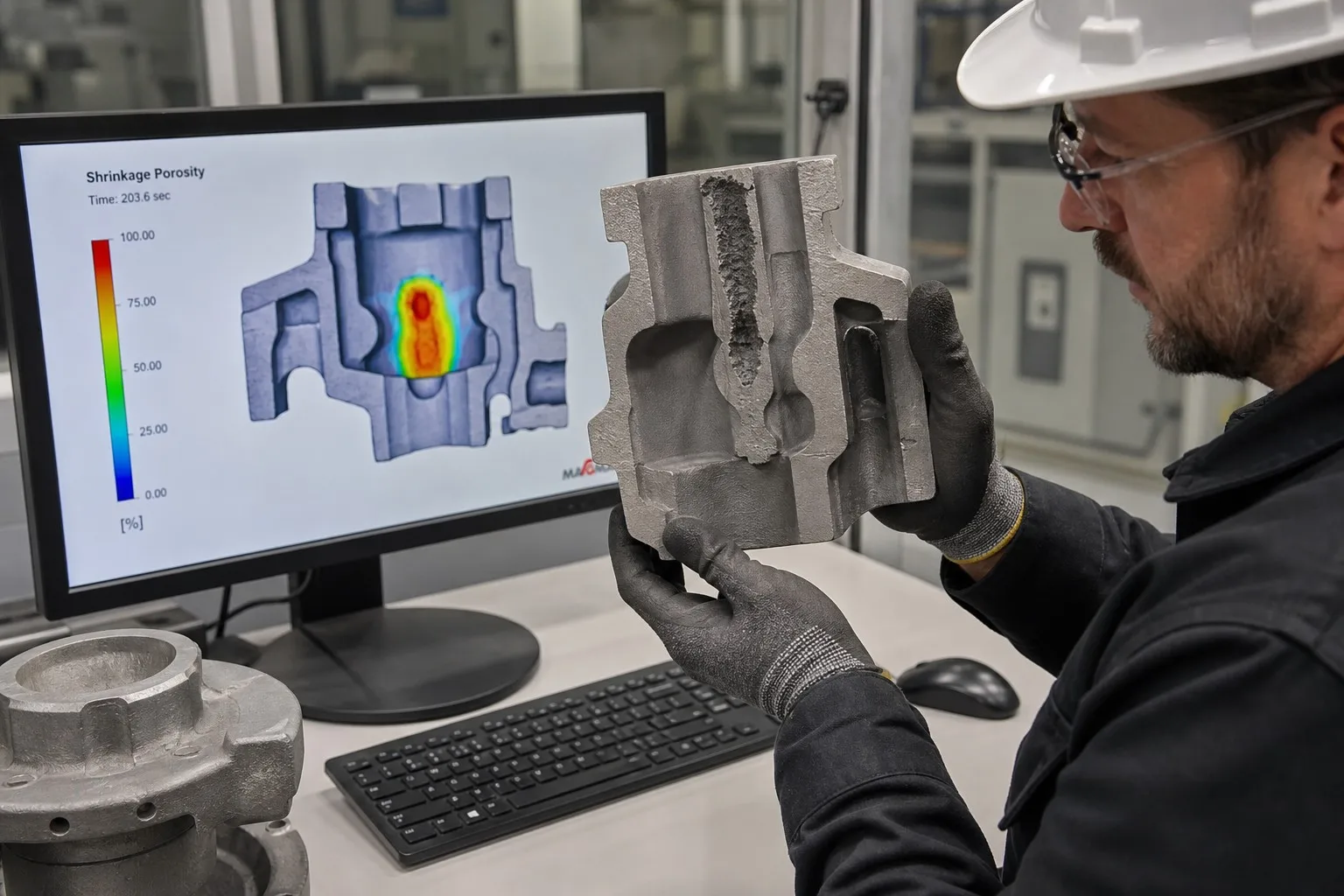 | Sectioning | Cut castings to verify shrinkage location prediction | | Temperature measurement | Thermocouples in mold vs. simulated cooling curves | | Microstructure checks | Compare predicted vs. measured properties | | Iteration | Calibrate material data and boundary conditions |
A calibrated simulation model — validated against actual foundry results — is far more reliable than an unvalidated one, because it carries the foundry's real process fingerprint.
6. Measurable Benefits
| Benefit | Typical Result |
|---|---|
| Defect reduction | 30-70% fewer defects on new tooling |
| Development time | 30-60% faster time to first good casting |
| Scrap reduction | 20-50% lower scrap in production |
| Yield improvement | 5-20% higher casting yield (less riser metal) |
| Tooling iterations | From 3-5 trial pours to 1-2 |
| Risk reduction | Design issues found in days, not months |
7. Simulation and the Buyer
When selecting a casting supplier, ask:
| Question | Why It Matters |
|---|---|
| Do you run simulation on new parts? | Indicates engineering culture, not just production |
| Which software? | Industry-standard tools indicate investment |
| Can you share the simulation report? | Transparency; verify the design was engineered |
| Do you validate simulation vs. production? | Calibration quality |
| How many design iterations do you simulate? | Robustness of the process window |
A supplier who simulates before pouring is investing in quality before the first part exists — the cheapest time to find defects.
8. Case Study: Heavy Casting Optimization
For a large heavy-section casting (e.g., a 20-ton slag pot or valve body):
- 3D model meshed with casting and mold
- Filling simulation shows critical pouring plan and velocity at the gating system
- Solidification simulation identifies hot spots at trunnion/flange junctions
- Riser system redesigned — multiple risers with insulation sleeves positioned at hot spots
- Chills added in heavy sections to accelerate cooling
- Simulation confirms directional solidification; defects move into risers
- First pour validates the simulation — sectioning shows sound metal
Result: one successful prototype instead of three failed pours; the risk of internal shrinkage eliminated before production.
Conclusion
Casting simulation has moved foundry engineering from experience-based trial to physics-based prediction. For complex and heavy castings — where a failed pour costs tens of thousands of dollars and weeks of schedule — simulation is not a luxury, it is the responsible way to design.
Dandong City Pengxin Machinery Co., Ltd. applies casting simulation to new part development across its sand, shell mold, and investment casting lines — predicting filling, solidification, shrinkage, and distortion before tooling is committed. Simulation results are shared with customers as part of the DFM review, and validated on the foundry floor at first article.
If you are developing a casting — large or small — ask us for the simulation study. It is the most honest preview of your part's quality that exists before the metal is poured.
Dandong City Pengxin Machinery Co., Ltd. — Heavy Castings and Precision Machining, Since 1958.
Products
Hot News
-
Cast Iron Components in Grain Mill Machinery
-
![Your Trusted Partner For Premium Cast Iron Bollards——Pengxin]()
Your Trusted Partner For Premium Cast Iron Bollards——Pengxin
-
![Production and Delivery Delays of Exhaust Manifolds in China]()
Production and Delivery Delays of Exhaust Manifolds in China
-
![Reciprocating & Process Gas Compressor Casing Castings: High-Pressure Hydrogen, Compacted Graphite Iron (CGI / GJV-450), and NACE Compliance]()
Reciprocating & Process Gas Compressor Casing Castings: High-Pressure Hydrogen, Compacted Graphite Iron (CGI / GJV-450), and NACE Compliance


Contact Us
- Phone:+86 15941574876
- Fax:0415-7875330
-
Email:jackma@px-casting.com